
Euro 5 is the current standard. Euro 5+ takes effect in 2025. But what comes after that?
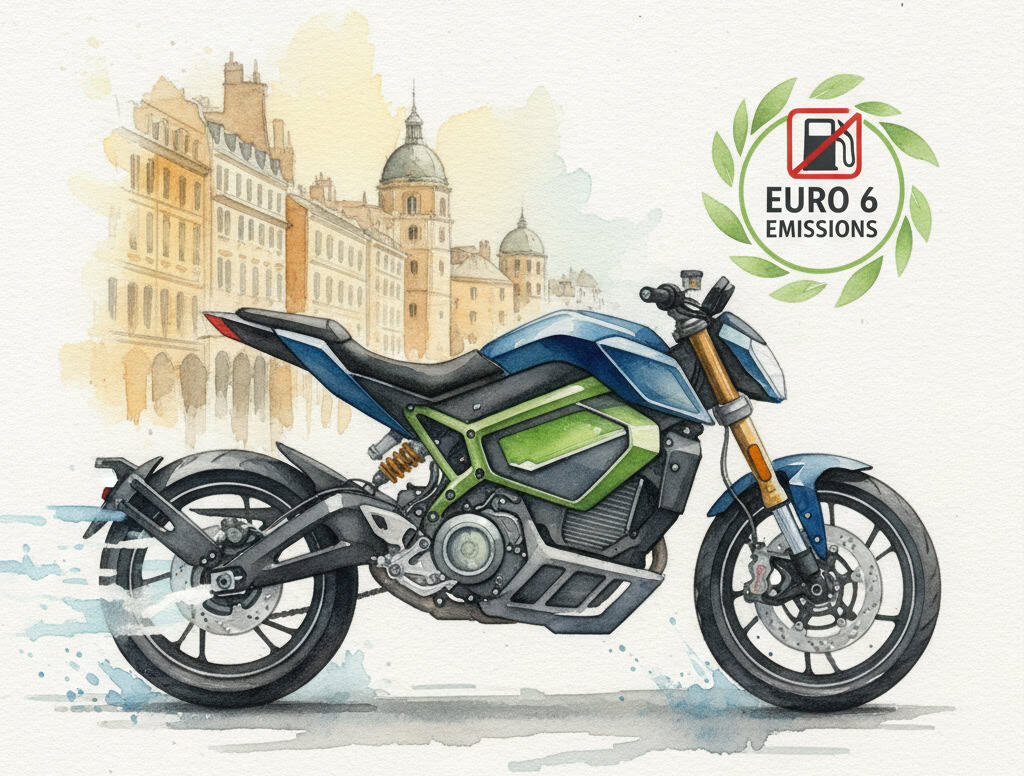
Euro 6 for motorcycles hasn’t been officially announced yet. But we know it’s coming—the question is when, and what it will require.
Beyond that looms the 2035 deadline: the EU’s proposed ban on sales of new internal combustion engine (ICE) vehicles.
Let’s talk about where motorcycling is heading—and what it means for riders.
Euro 5+ (2025): What’s Actually Changing
Starting January 1, 2025, Euro 5+ implements stricter enforcement and testing for motorcycles:
OBD-II (On-Board Diagnostics Stage II):
More comprehensive monitoring of emission systems. If critical components like catalytic converters or oxygen sensors fail, the system detects it and alerts the rider. This is more advanced than the OBD Stage I required by Euro 4.
Extended Durability Requirements:
Emission control systems must maintain effectiveness for at least 20,000 km, often more depending on the bike. Manufacturers must prove their systems don’t degrade prematurely.
Real Driving Emissions (RDE) Testing:
Lab tests are still required, but bikes must also meet standards in real-world riding conditions. No more optimizing purely for controlled test environments.
Stricter Noise Limits (Expected):
While not officially confirmed yet, noise pollution is expected to be addressed more aggressively going forward. Quieter exhausts are likely coming.
Euro 5+ is essentially a refinement and enforcement upgrade. The emission limits themselves don’t change dramatically—but proving compliance gets harder.
Do you think noise limits are necessary, or should motorcycles be allowed to be loud?
Euro 6 for Motorcycles: What to Expect
Euro 6 for cars has been in effect since 2015. Motorcycles will eventually follow, but the timeline isn’t confirmed.
What Euro 6 will likely include:
Even stricter emission limits:
Hydrocarbons, nitrogen oxides, and particulate matter will all face tighter restrictions. Expect limits closer to (or matching) Euro 6 car standards.
Mandatory RDE testing:
Real-world emissions testing will probably become standard, not optional.
Tighter noise regulations:
Noise pollution has been a growing concern. Euro 6 will likely set stricter decibel limits, especially for sport bikes and high-performance models.
More advanced diagnostics:
OBD systems will monitor more components, catch failures earlier, and potentially limit bike performance if critical emission systems fail.
Longer durability requirements:
Emission components may need to remain effective for 30,000-40,000+ km instead of 20,000 km.
Will bikes still perform well? Probably. Manufacturers have adapted to every previous Euro standard. But expect:
- Higher costs
- More complex systems
- Potentially more models discontinued or redesigned
- Quieter exhausts
The Big Question: Usable Lifespan
One concern that keeps coming up: will emission sensors and components limit how long you can actually ride a bike?
If oxygen sensors fail at 25,000 km and cost €500 to replace, that’s frustrating but manageable. But what if catalytic converters degrade at 50,000 km and cost €2,000 to replace? What if OBD-II systems throw error codes that prevent the bike from running without expensive dealer intervention?
Nobody knows yet. Euro 5 bikes are still relatively new. We won’t know the long-term maintenance reality for years.
Optimistic view: Durability requirements mean components last longer, and total ownership costs stay reasonable.
Pessimistic view: Complex emission systems become expensive to maintain, and bikes become economically unviable after 10-15 years.
The truth is probably somewhere in the middle. But it’s a legitimate concern for anyone who wants to keep a bike for decades.
Are you worried about long-term maintenance costs on modern emission-controlled bikes?
The 2035 ICE Ban: What Actually Happens?
The European Union, UK, Canada, Norway, China, and California have proposed banning sales of new internal combustion engine vehicles by 2035.
Important clarifications:
This only affects new vehicle sales. You can still ride your current gasoline-powered bike. You can still buy used ICE bikes. You just won’t be able to buy a new ICE bike from a dealer after 2035.
It’s still a proposal. Political opposition, economic concerns, and practical challenges could delay or modify the ban. It’s not guaranteed.
Enforcement details are unclear. Will there be exemptions for certain vehicle categories? Will synthetic fuels (e-fuels) be allowed? Will the deadline get pushed back?
Market dynamics will be interesting. Will ICE bike sales spike in 2034 as riders rush to buy the last generation? Will prices inflate? Will manufacturers stockpile inventory?
2035 is only a decade away. That’s not much time for the industry to fully transition to electric.
The Electric Question
By 2035, will electric motorcycles be good enough that most riders won’t care about losing ICE bikes?
Current state of electric motorcycles:
Pros:
- Instant torque
- Zero emissions (at point of use)
- Lower maintenance (no oil changes, valve adjustments, chain maintenance on some models)
- Potentially cheaper to “fuel” (electricity vs gasoline)
- Quiet (benefit or drawback depending on your view)
Cons:
- Limited range (100-200 km typical)
- Long charging times (30 minutes to several hours)
- Charging infrastructure still developing
- Higher upfront costs
- Battery degradation over time
- Heavier than comparable ICE bikes
- Lack of sound/character that many riders love
Will this improve by 2035? Probably. Battery technology is advancing. Charging infrastructure is expanding. Costs will likely drop as production scales up.
Will it be enough? That’s the question. Some riders will embrace electric. Others will hold onto ICE bikes as long as legally possible.
Would you consider switching to an electric motorcycle, or is ICE non-negotiable for you?
Hybrid Motorcycles: The Middle Ground?
Some manufacturers are exploring hybrid motorcycles—combining small combustion engines with electric motors.
Potential benefits:
- Extended range compared to pure electric
- Lower emissions than pure ICE
- Electric assist for low-speed riding, ICE for highway cruising
- Potentially the best of both worlds
Challenges:
- Complexity (two powertrains = more weight, more cost, more to maintain)
- Still unclear if riders actually want this
- May not satisfy either ICE purists or electric enthusiasts
Hybrids make more sense for cars (where weight and space are less critical) than motorcycles. But they might be a transitional technology between ICE and full electric.
What Happens to the Used Market?
If new ICE bikes are banned in 2035, the used market will become crucial.
Likely scenarios:
Pre-2035 bikes hold value longer. Classic ICE bikes might become collectibles. Final-generation models (2034-2035) could appreciate rather than depreciate.
Maintenance becomes more important. If you can’t buy new ICE bikes, keeping old ones running becomes essential. Mechanics specializing in ICE maintenance will stay in demand.
Parts availability concerns. Will manufacturers continue producing parts for discontinued ICE models? How long will support last?
Grey market imports. If other regions still allow ICE bikes, will there be ways to import them? (Probably not legally in EU markets.)
The used market could look very different post-2035.
My Take
I’m not anti-electric. If electric bikes become practical—good range, fast charging, affordable—I’d consider one. Obviously, my goal is to ride a Niken GT, which is Euro 5 compliant.
But I’m skeptical that the technology will be ready for everyone by 2035. Range anxiety is real. Charging infrastructure isn’t universal. Batteries degrade. And many riders (myself included) genuinely love the sound, feel, and character of combustion engines.
Euro 6 is coming. Bikes will adapt, get cleaner, probably get more expensive. Manufacturers will figure it out—they always do.
The 2035 ban is more uncertain. It might happen. It might get delayed. It might include exemptions or allowances for synthetic fuels. Politics and economics will play huge roles.
What I know for sure: the motorcycling landscape in 2035 will look very different from today. Whether that’s better or worse depends on your priorities—cleaner air, lower emissions, climate impact versus performance, character, tradition, and rider preference.
Where do you stand? Ready for electric, or holding onto ICE as long as possible?